Learn the patterns. Model the future.
Forecasting models and APIs for understanding the world over time.
Start with your history. Compare a forecast. Make a decision you can explain.
Explore the live subnet dashboard, run Gnomon locally, or sign up for hosted forecasting through Ephemeris.
Cascade trains forecasting models, Weir scores them, Ephemeris serves them alongside other models, and Gnomon lets agents put them to work.
Open competition on the data recipes used to train forecasting models, with architecture and training conditions held constant. Many independent builders run parallel experiments; an identical model and an unseen benchmark decide.

Weir is built on TSBenchforge, Cascade’s continuously updated time-series evaluation framework. It compares forecasting models on held-out time series. Public benchmark results will be linked here when they are available.
Ephemeris is Cascade’s hosted forecasting API, serving Cascade models alongside other forecasting models. Sign up for Ephemeris ↗
Gnomon lets people and agents inspect a time series, run a chosen model and compare it with a baseline. Start locally through its CLI, Python API or MCP tools; hosted API access is optional. Gnomon introduction (PDF)
MODELS+ EVIDENCE+ FORECASTS= OUTCOMES 04 / 04
The cost of getting the future wrong

Plan capacity before demand arrives.
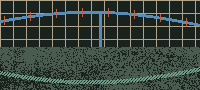
Weekly orders follow a repeating cycle while the baseline gradually grows. Forecast the next cycle to plan stock and capacity for the busier weeks.

- History
- Illustrative forecast
- Scenario range
Bring a regular series of orders, workload or another business metric.
Compare a model with a simple baseline on past data before using it.
Plan for a range of demand levels, with the assumptions recorded.
Most of the data that runs the world is a time series, and agents are increasingly being asked to act on it.
Language models learn from text. Time-series reasoning depends on something different: seasonality, lag structure, regime changes and uncertainty are properties of the process itself, and a model can explain a chart convincingly without having a strong prior for how that process will evolve. Specialist models are beginning to supply that capability, but a better forecaster does not solve the whole problem. Software acting on a forecast needs to know where it came from, how strong the evidence is, and whether it should still be trusted.
Reading

| document | what it covers | format | length |
|---|---|---|---|
| Learning the grammar of time | what an operator needs around a forecast | litepaper | 8 min |
Put Gnomon to work.
Inspect time series, run forecasts and compare results through your agent.
installcurl -fsSL https://raw.githubusercontent.com/TensorLink-AI/Gnomon/main/install.sh | bash -s -- --version mainhermes mcp add gnomon --command gnomon --args mcp serveThe Ephemeris forecasting API is live. Sign up to start forecasting.